As the British Empire flourished in the second half of the nineteenth century, so did international trade and the numbers of people travelling overseas from London, Birmingham, Manchester, Liverpool and the rest of Britain’s industrial centres. At the same time, ocean going ships were getting larger and larger bringing an unprecedented rise in traffic at the country’s ports, particularly on the southern coast at Dover, Southampton, Portsmouth, and Plymouth.
The concept of the “Boat Train” is not difficult to understand; integrating rail travel with passenger, and cargo, ships for onward journeys to the continent with as little disruption as possible. Trains able to disembark their passengers right alongside a ship so that they could make their sea crossing, and most likely then, to board another train to their final destination.
The London and South Western Railway (LSWR) Company served the south and west of England from 1838 to 1922. They were one of the great pioneers of Britain’s rail network and were responsible for the rebuilding of Waterloo station, in London, and its becoming one of the great stations of the world.
LSWR started running “boat-trains” from Waterloo to Southampton as early as 1856, for connection with the Union Line steamers to Cape Town. The trains consisted of loose vehicles, but just before the turn of the century special trains were built for conveying prosperous American passengers to trans-Atlantic liners operating from Southampton and Plymouth. These were known as “American Boat Trains, or the “American Eagle Express” as luxury First-Class “Eagle” rolling stock , specifically designed to attract wealthy American businessmen, was used in the trains.
Waterloo Station c.1913
American Boat Train Express.
Journey time for the 79 miles from Waterloo to Southampton Docks was 1 hour 40 minutes
In 1907, the White Star Line, previously based, in Liverpool, moved its premier services to Southampton in readiness for when the Olympic Class liners started their trans-Atlantic services to New York. White Star Line’s Royal Mail steamers Adriatic, Oceanic, Majestic, and Teutonic also transferred to Southampton. By 1908, White Star Line had fully established its premier services, sailing to New York every Wednesday. Boat trains departed from Waterloo at 08:30 a.m. and 09:30 a.m., the later train, principally for First-Class passengers. The late breakfast boat train departure from Waterloo to Southampton as known was the ‘White Star Express’, and included new corridor compartment carriages as well as First-Class “Eagle” saloons.
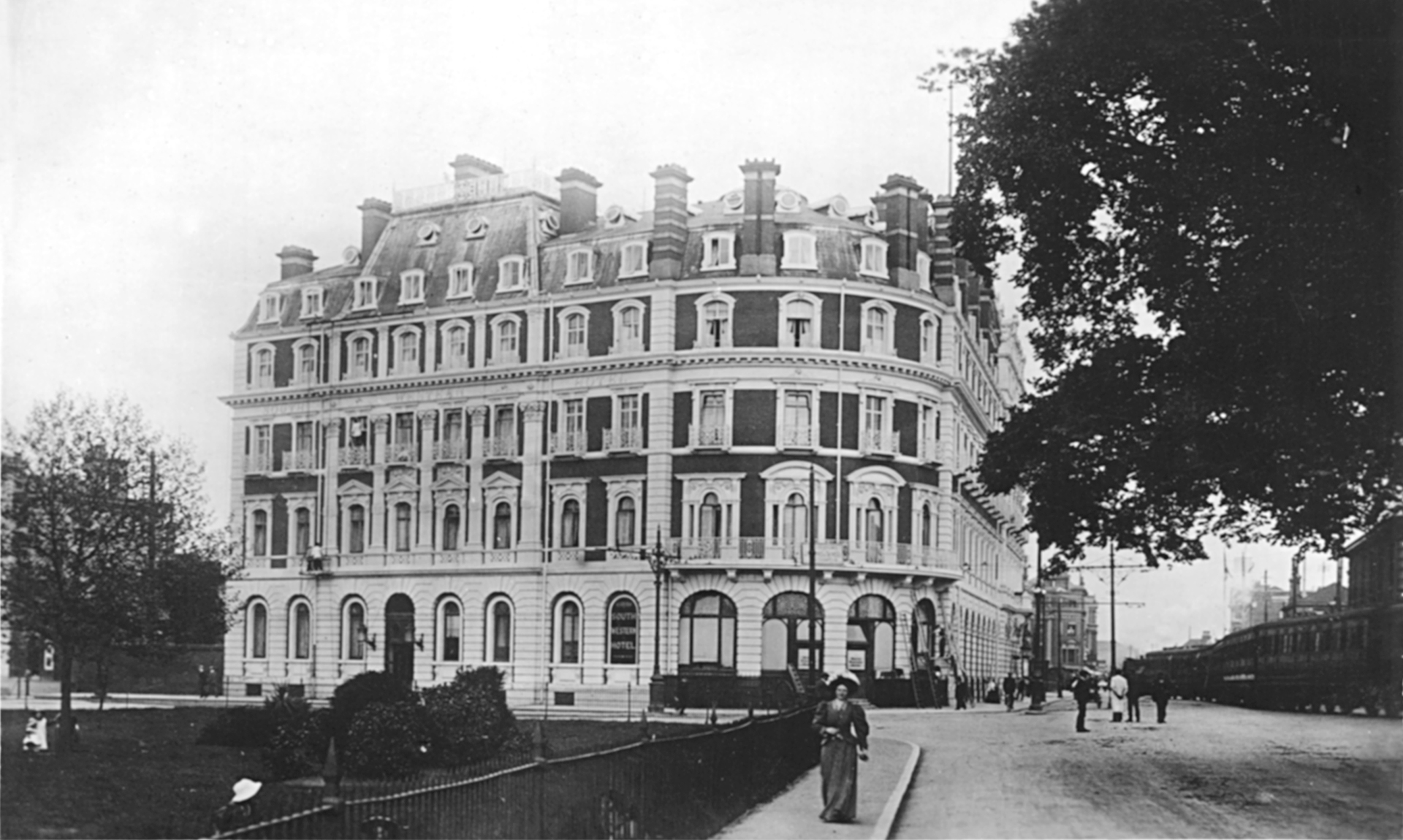
The South Western Hotel (as it was) on Canute Road, Southampton. Trains from Waterloo could stop here for passengers who were stopping the night for a boat in the morning, rather than alight at the docks for boarding.
This shows the lines coming into the station (Southampton Terminus) The back of the South Western Hotel (in the background right). The platforms extended right into the hotel originally. The docks can be seen, and the boat trains would cross Canute Road and into White Star/Ocean Dock.
Boat train entering the docks having crossed Canute Road. The South Western Hotel in the background. The locomotive pulling the train is the Southern Railway N15 4-6-0 King Arthur Class, locomotive number 774. Sir Gaheris, which came into service in 1925. Re-numbered as 30774 in April 1949. Withdrawn from service in January 1960 and scrapped at Eastleigh. So this narrows down the date range of the photograph to between 1925 and early 1949.
Photograph taken in 1977 of the same view as above. The station closed for passengers and parcels on the 5th of September 1966 and most of the track was removed. In 1970, the remaining signal box and track was removed and the running lines were filled in to platform level to form the car park that it is today.
This photograph, taken in 1936 on the occasion of the maiden voyage of R.M.S. Queen Mary, shows the Cunard White Star terminal building at Berth 46. Railway lines on both sides of the building serviced the boat trains and cargo trains.
Boat train leaving the newly finished Ocean Terminal in 1950. The platform inside the terminal building from where passengers could take the escalator upstairs to the lounge, and then board the ship. The baggage would be load directly on to the ship from the baggage hall below. The locomotive is Southern Region West Country Class 34094 Mortehoe, and the liner is R.M.S. Queen Elizabeth.